
How can you measure the real business impact of an enterprise AI project?
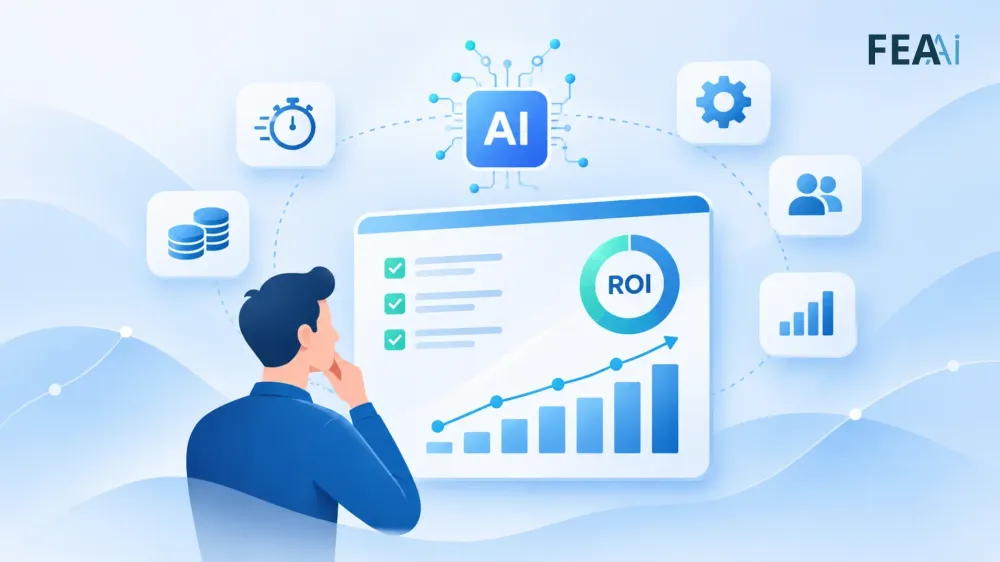
Egy sikeres demó után a pénzügyi vezető joggal kérdezi meg, mi ebből a ténylegesen igazolható haszon, és ilyenkor a lelkesedés kevés, bizonyíték kell. A technológiai teljesítménymutatók ritkán válaszolnak erre, a költségvetési tárgyalásokon mégis gyakran ezekre hivatkozunk. Vajon mely mérőszámok állják meg a helyüket egy auditálható üzleti értékelésben, és mire érdemes figyelni, hogy a számok ne csak a prezentációban legyenek meggyőzőek? Az alábbiakban ezt a kérdést járjuk körül a kiindulási problémától a megtérülés számításáig.
Artificial intelligence is becoming part of everyday business operations, but investing in AI does not automatically create business value. A successful demonstration or a technically advanced solution says little about its actual impact on a company. The real question is whether AI helps employees work more efficiently, reduces operational costs, or improves business decisions. So how can companies measure the return on investment (ROI) of an enterprise AI project?
Start with the business problem, not the technology
Before introducing AI, companies should identify exactly what they want to improve. Is customer service taking too long? Are employees spending hours processing documents? Does preparing management reports require collecting information from several systems?
Each problem requires a different measure of success. For document processing, it might be the time needed to handle a request. For customer service, response times and resolution rates may be more relevant.
This distinction matters because, as discussed in why many AI implementations fail to deliver results, technology alone does not guarantee meaningful business outcomes.
Which KPIs reveal the real value of AI?
An AI project's success should be measured through business KPIs rather than technical performance alone.
Four indicators are particularly useful:
- Time savings: How many working hours does AI save each month?
- Cost reduction: How much does it reduce operational expenses or rework?
- Process quality: Are fewer errors occurring, and are tasks completed more consistently?
- Business performance: Does the solution improve customer satisfaction, processing capacity, or revenue?
For example, imagine a company processing 2,000 invoices monthly. If AI reduces handling time from six minutes to two, the theoretical saving is approximately 133 working hours per month.
However, saved time is not automatically equivalent to reduced costs. Its financial value depends on whether employees can redirect that capacity toward productive work or whether actual expenses decrease.
Measure the entire workflow, not just individual tasks
One common mistake is measuring how quickly an AI tool completes a single action while ignoring the rest of the process. An AI solution might extract information from invoices in seconds, but if employees still need to copy the results into another system, the overall benefit remains limited.
This is where AI agents capable of executing business workflows become relevant. By connecting different applications, they can support multiple consecutive steps rather than optimizing isolated activities. The right metric is therefore not simply how fast AI performs a task, but how much faster the complete business process becomes.
How do you calculate AI project ROI?
The financial evaluation should include development, integration, infrastructure, maintenance, and employee training costs.
A simplified ROI calculation is:
ROI = (Financial benefits − Total project costs) / Total project costs × 100
Suppose an enterprise AI solution costs €40,000 to implement and operate during its first year, while generating €65,000 in measurable annual benefits.
Its first-year ROI would be 62.5%.
However, these figures should be based on actual measurements rather than optimistic forecasts. Comparing performance before and after implementation, ideally against an unaffected control group, provides a more reliable picture.
Don't overlook quality, reliability, and adoption
A faster process is not necessarily a better one. If AI creates additional errors, requires extensive human correction, or introduces security risks, its financial benefits may quickly disappear. This is why transparent quality assurance management and continuous monitoring matter when evaluating enterprise AI solutions.
Organizations should also track employee adoption, exception rates, and the frequency of human intervention. A system that works perfectly in a pilot but is rarely used in everyday operations creates limited value.
From AI experimentation to measurable business value
As AI becomes increasingly integrated into enterprise software, its success will be judged less by technological novelty and more by its contribution to business performance.
Companies that define measurable objectives before development and continuously evaluate results will be better positioned to expand successful solutions. The next stage of enterprise AI adoption will not simply be about implementing more AI tools, but about building business processes in which their value can be demonstrated.
- AI-supported custom software development
- AI